
Maybe you are getting ready for your first hike. Maybe you go on frequent adventures and are wondering what you could add (or take away!) from your current set-up. Or maybe you just like gear. Either way, let me show you what I keep in my hiking backpack for a day on the trail!
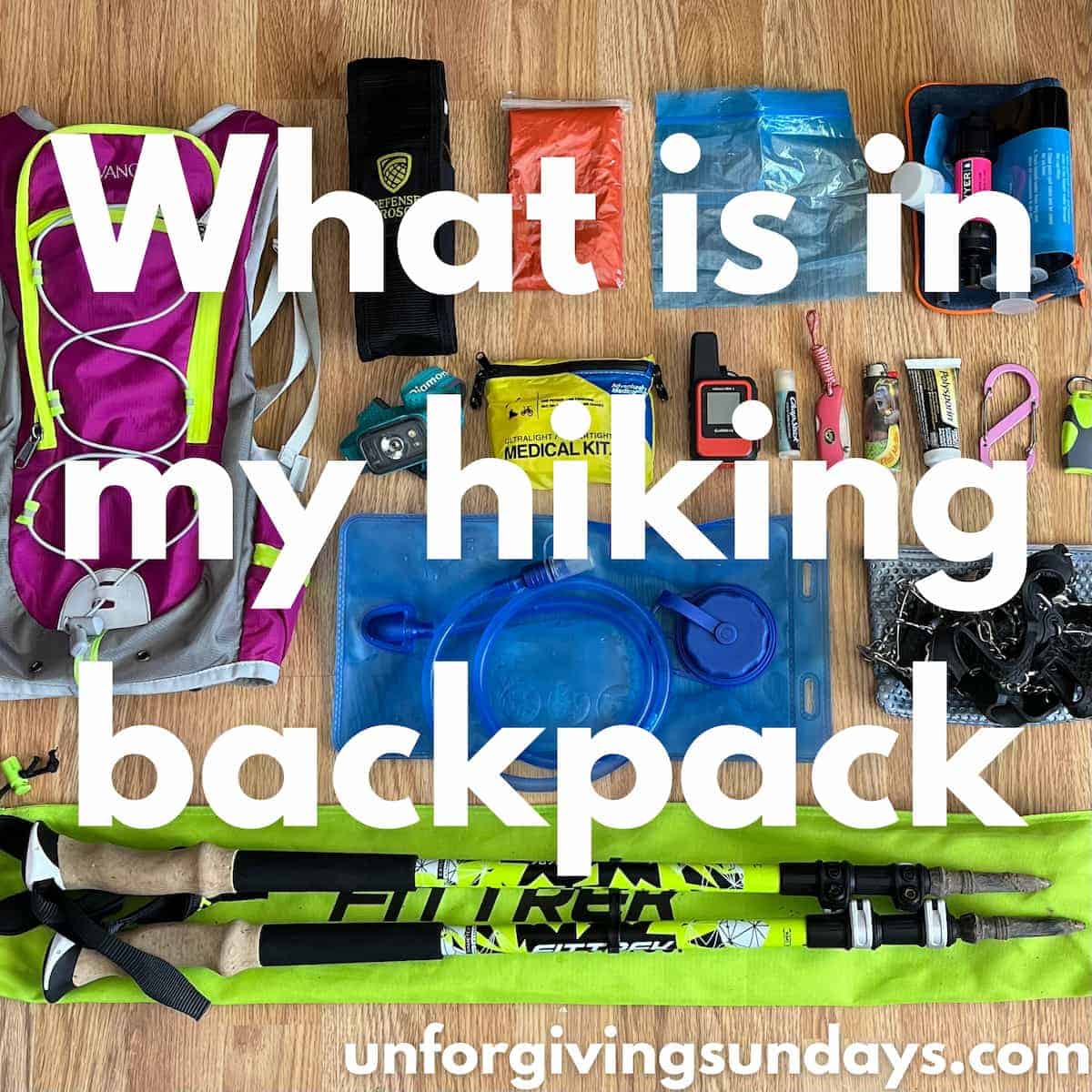
Living an hour from the Rockies means I’ve had a lot of time to fine-tune my daypack. First, we’ll cover the “10 Essentials,” and then I’ll take you pocket-by-pocket through what actually makes the cut (and what doesn’t).
The 10 Essentials
When you head out into the wild, you should be prepared to take care of yourself if something goes wrong. The experts from Mountaineering: The Freedom of the Hills suggest that, at a minimum, you always carry these “10 Essentials”:
- Navigation
- Headlamp
- Sun protection
- First aid
- Knife
- Fire
- Shelter
- Extra food
- Extra water
- Extra clothes
It is a good list, and I do (mostly) carry these things — after all, who am I to argue with the experts?
Hiking Backpack — Main Pockets
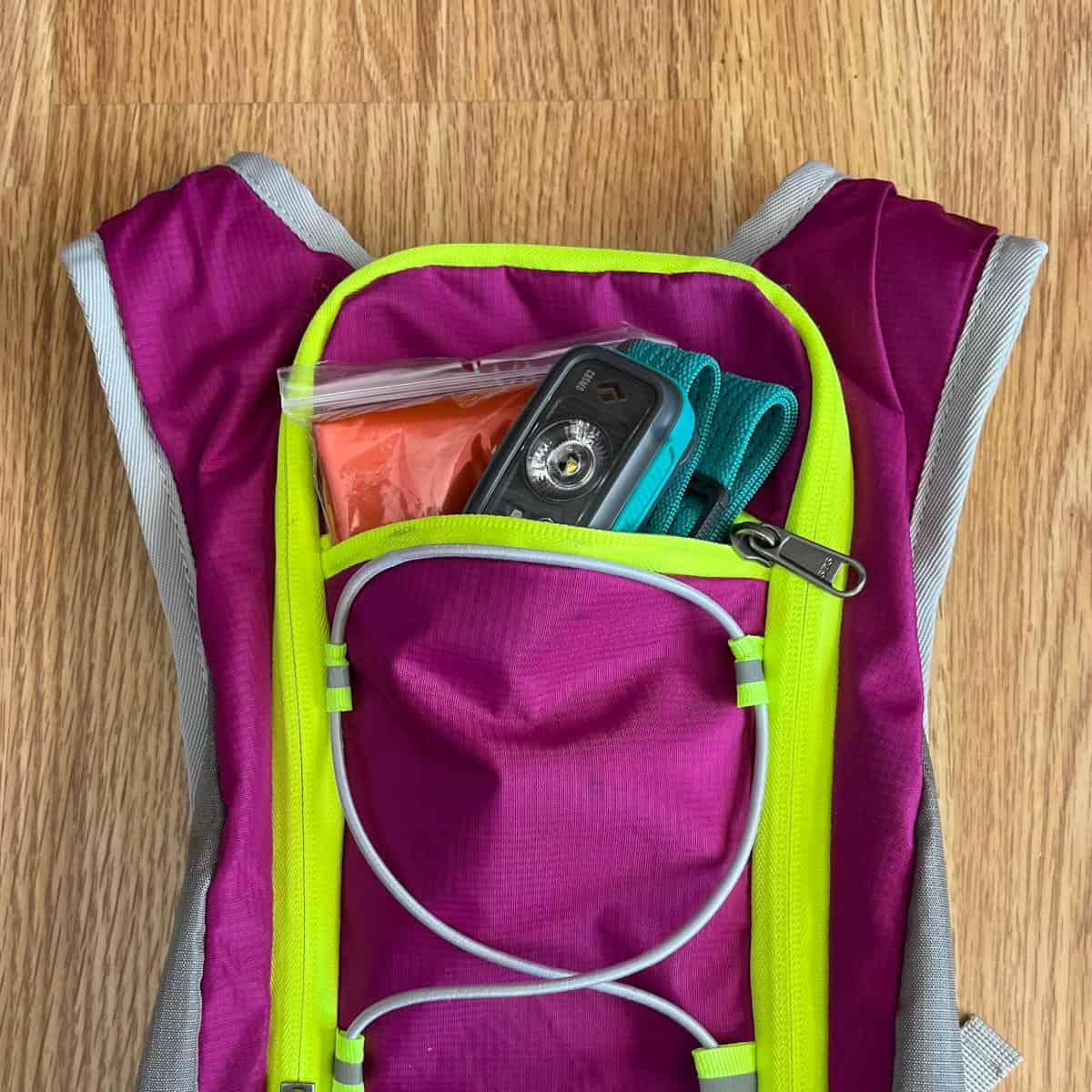
In the smaller front pocket, I keep:
- Headlamp
- Emergency blanket
Headlamp: I used to carry a headlamp just because I was “supposed” to — when am I going to need a headlamp on a day hike? Turns out, you never think you’ll need it until you do. Last summer, I decided to take a “shortcut” (it was not a shortcut) and added two unexpected hours to my hike. Then my phone (a.k.a. my flashlight) died. I made it back to my car about 15 minutes before dark. While I didn’t end up using my headlamp, I was very glad to know it was there.
Emergency blanket: Have I ever used the emergency blanket? No… but it is cheap and light, and could really make a difference if something ever happened. I carry this to tick off the “shelter” box on the 10 Essentials list.
- Notes from the Field Lab: Emergency blankets work by reflecting your body heat back at you. They can reflect up to 90% of your body’s heat!
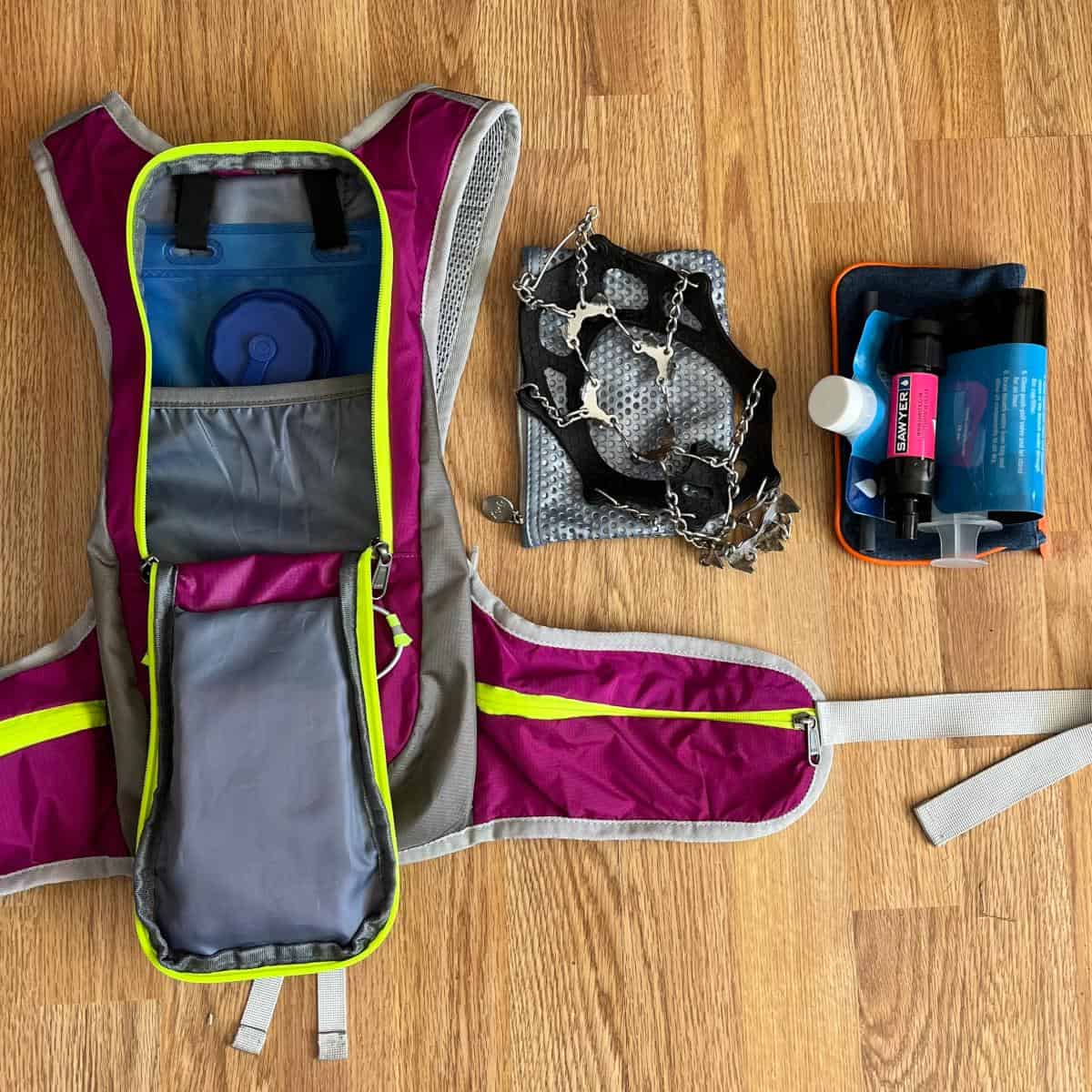
In the larger back pocket, I keep:
- Water bladder
- Shoe spikes
- Sawyer Mini water filter
- Food (not pictured)
Water bladder: I use a water bladder instead of a water bottle because it fits better in a small pack like mine. I like that it has a wide mouth so I can fit ice cubes; the downside is that the heat of my body against the backpack warms the water up quickly.
Shoe spikes: As a Canadian, I like to carry shoe spikes. These slip over my boots (hiking or snow) and really help with traction. They are good for snow and ice, but they also work really well in muddy grass. I store them in a pouch, which keeps them together and keeps the grime out of my backpack. I like to have these on me because you never know when they might come in handy. (But I leave them in the car for July and August!)
* I love these shoe spikes from Geartrade (and not just because the company was founded in Okotoks, Alberta!)
Water filter: You should always have a backup plan, even on short hikes, in case you run out of water. There are lots of different options for purifying water, but I have a Sawyer Mini water filtration system. It comes with a drinking pouch that you could fill up in a stream, and then the filter screws on and you are able to drink like a straw from the filter. I keep everything in another pouch.
- Notes from the Field Lab: The Sawyer Mini filters out bacteria and protozoa, but not viruses — though in most of Canada, that’s not a big concern. Just don’t use it to drink from questionable puddles in parking lots.
Food: I usually pack a sandwich and snacks. My favorite snacks to bring are fruit, pepperoni, and trail mix. Whatever you decide to bring, make sure to pack extra, just in case.
Hiking Backpack — Waist Pockets
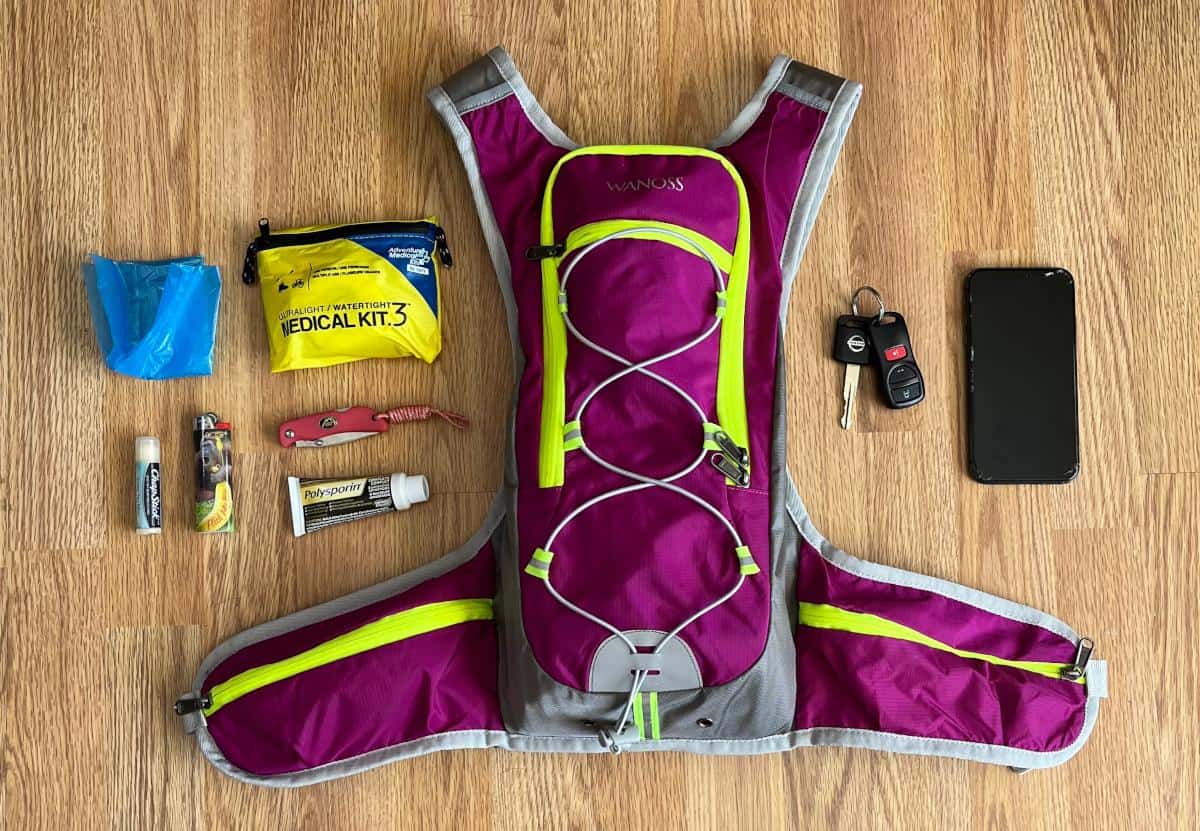
In the left waist pocket, I keep:
- Ziploc bag
- First aid kit – with an extra day of prescription medications and tweezers for ticks
- Chapstick
- Lighter
- Pocket knife
- Polysporin
Ziploc bag: These come in handy at the weirdest times, but the main reason I carry a Ziploc bag is to pack out any of my own garbage or garbage that I find along the way.
First aid kit: I always kind of scoffed at first aid kits — just don’t fall down, right? (And really, by that logic I should be carrying an ambulance instead of just a first aid kit…) Luckily I carried one anyway because one day I was hiking back to the car and I started to get a blister. I continued on because we weren’t more than a half hour from the car and because I didn’t really understand how quickly things could go bad. It was only minutes later and the blister had become so bad that I couldn’t walk any more. If it wasn’t for my first aid kit, I probably would’ve had to take my shoes off to finish the hike (or have my buddy carry me out). After that experience, I will happily carry a first aid kit (with extra Leukotape!) in my hiking backpack for the rest of my life. And that was only over a blister.
* In my first aid kit, I also keep a pair of tweezers (in case of ticks) and an extra day of prescription medication (and replace it each season).
Chapstick: Not everyone will want to carry Chapstick, but if this is something that you like to use, you’ll be thankful to have it in your backpack. Plus, it really doesn’t take up much space.
- Notes from the Field Lab: As elevation increases, so does UV exposure — every 1,000 metres add 10-12% more UV exposure. Consider looking for a lip balm with an SPF.
Lighter: If something happened and you had to spend a night in the woods, having a fire could be the difference between having a bad time and having a horrible time. If you feel like being extra prepared, you might want to consider carrying two ways to start a fire (e.g., matches and a ferro rod).
* Before you start a fire, make sure you are always following local fire regulations!
Pocket knife: My little pink pocket knife isn’t going to cut down a tree, but it would do the trick if I needed to cut fabric, rope, gauze, or Leukotape.
Polysporin: I recently replaced the expired items in my first aid kit. I couldn’t find any antibiotic ointment packets, so I carry a little tube of Polysporin. (The packets are ideal for hygiene reasons though.)
In the right waist pocket, I keep:
- Cell phone
- Car keys
Right waist pocket: I keep this pocket empty, and then always put my phone and keys in this pocket so I know exactly where they are. I like to use AllTrails to track my hikes on my phone — don’t forget to download the maps to use offline!
Hiking Backpack — Outside of the Bag
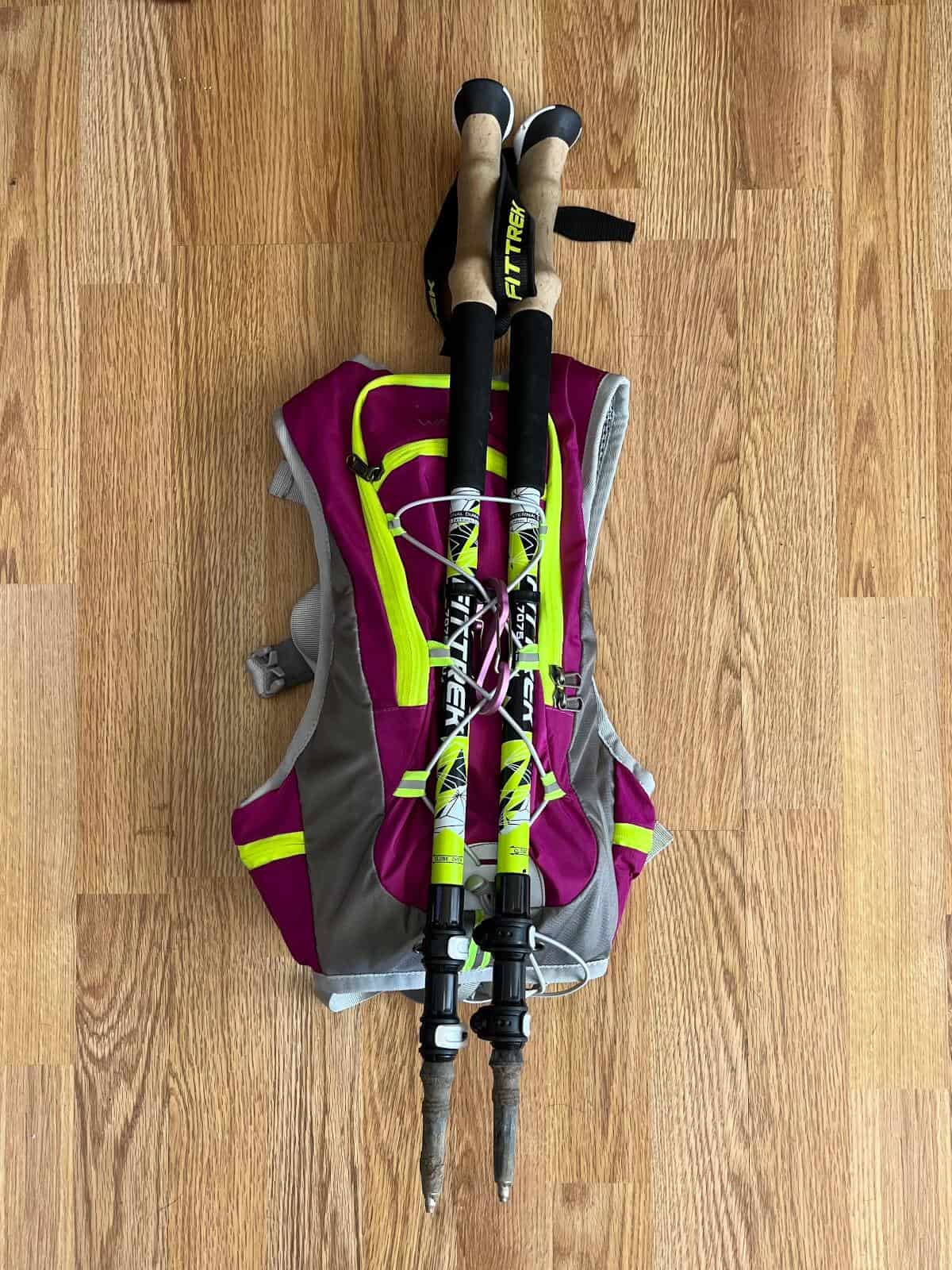
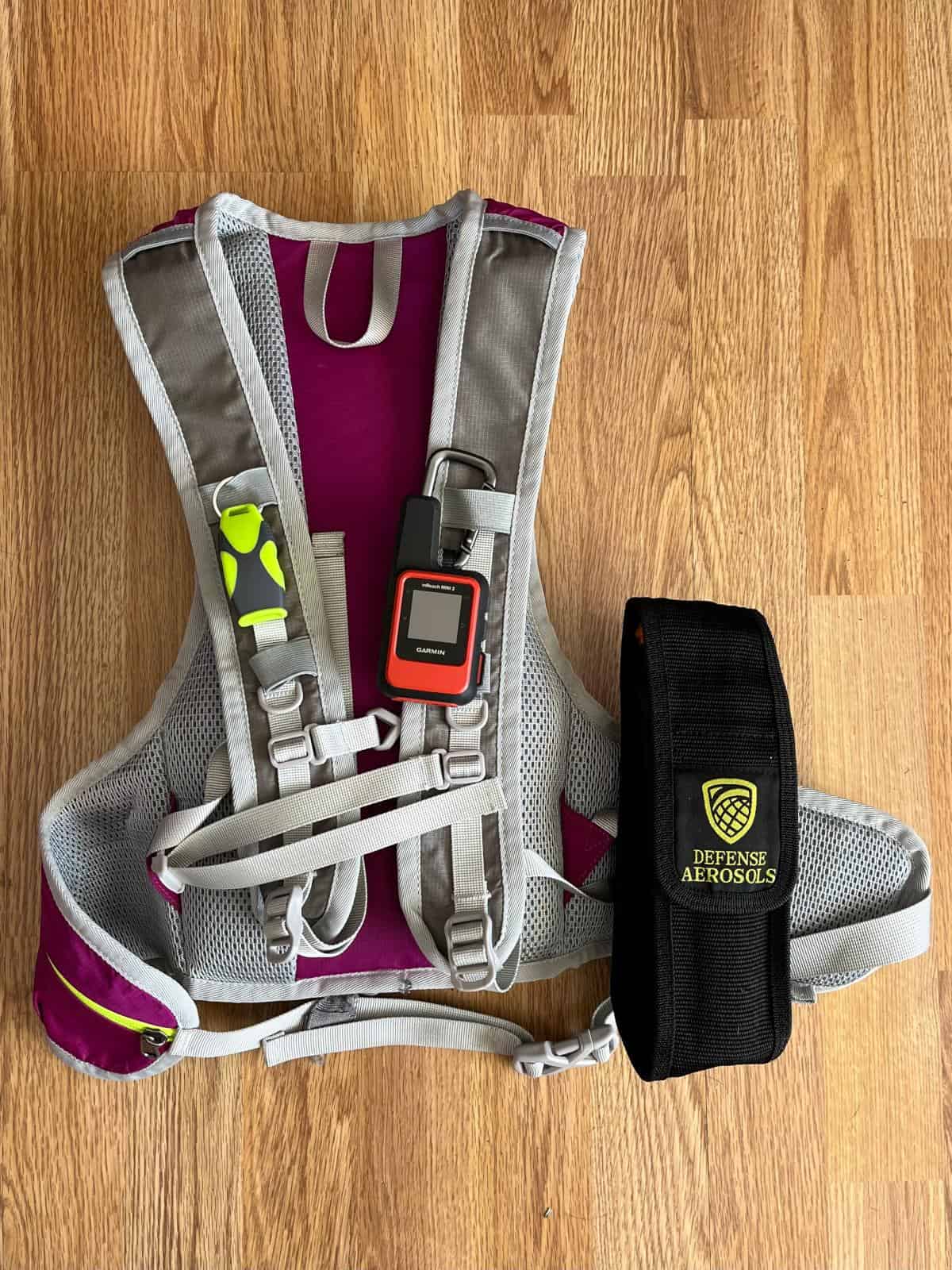
On the back of the bag, I keep:
- Trekking poles
- Carabiner
Trekking poles + carabiner: I find that the times where I don’t bring trekking poles end up being the times where I want trekking poles. I’ve started attaching them to my hiking daypack, so that they are always there if I want them. I use the carabiner to secure the poles to the backpack.
On the straps of the bag, I keep:
- Whistle
- Garmin inReach Mini satellite communicator
- Bear spray
Whistle: I carry a whistle to signal for help, if needed. I keep it on the outside of my bag, close to my face, so that I could still use it with limited mobility.
- Notes from the Field Lab: Three blasts means “I need help!”
Satellite communicator: I have a Garmin inReach Mini satellite communicator because I am a disabled girl who likes to hike by herself. It is a nice way to check in when I don’t have service, and it includes my location with the message. But most importantly, I can send SOS messages to Garmin, in the event of an emergency.
* This is 100% a luxury item that I have because I solo hike often (and that thought makes my mom cry). You absolutely do not need this for a day hike (even my fellow seizure queens) — hike with friends, choose trails that match your skill level, and tell someone where you are going and when you’ll be back.
** With that said, if you’re hiking with medical gear, fatigue, or chronic pain, your pack might look a little different. Take what you need to feel safe and have fun.
Bear spray: I always carry bear spray on my waist. It needs to be grab-able! Even in the winter, you never know when a dangerous animal might approach you.
Other things that I might pack in my hiking daypack
If you compare my list with the 10 Essentials, you’ll notice there are a few things I don’t carry regularly. It is not that I don’t think you should carry these things–again, who am I to question the experts–but it really depends on the situation.
Navigation: I obsessively track my hikes using AllTrails (because I love having the metrics) and it is nice because you can download the maps to use offline and can use the app to backtrack if you get lost. But phones die. If you are exploring a new area, take a printed map.
Sun protection: I always wear sunscreen, but I often forget to bring it (and bug spray) with me. (I know, I know — I should be reapplying more). Sometimes I escape unscathed and feel smug about not carrying the extra weight, sometimes I burn to a crisp and get destroyed by mosquitoes. I like to live dangerously. Hey, at least I always wear a hat.
- Notes from the Field Lab: You should be reapplying sunscreen every 2 hours, or more if you are sweating.
Extra clothes: I tend to dress in layers, so I don’t bring “extra” clothes. You might want a windbreaker as you get higher up the mountain; it can also be worthwhile to bring an extra pair of socks. I guess I might change my mind if it was really wet out? Regardless, it is important to know about hypothermia and hyperthermia so that you can be prepared — just check the weather and plan accordingly.
Gaiters: These protect you lower legs if you are hiking in the wet or mud, and are definitely worth packing during the shoulder seasons (spring and fall).
How heavy should your backpack be?
For a day hikes, don’t exceed 15% of your body weight. If the pack bothers your shoulders, adjust the hip straps so that your hips carry more of the load.
Packing heavier items closer to your back will help your centre of gravity and make your load feel lighter.
Summary
So there you have it! This is what is in my hiking backpack!
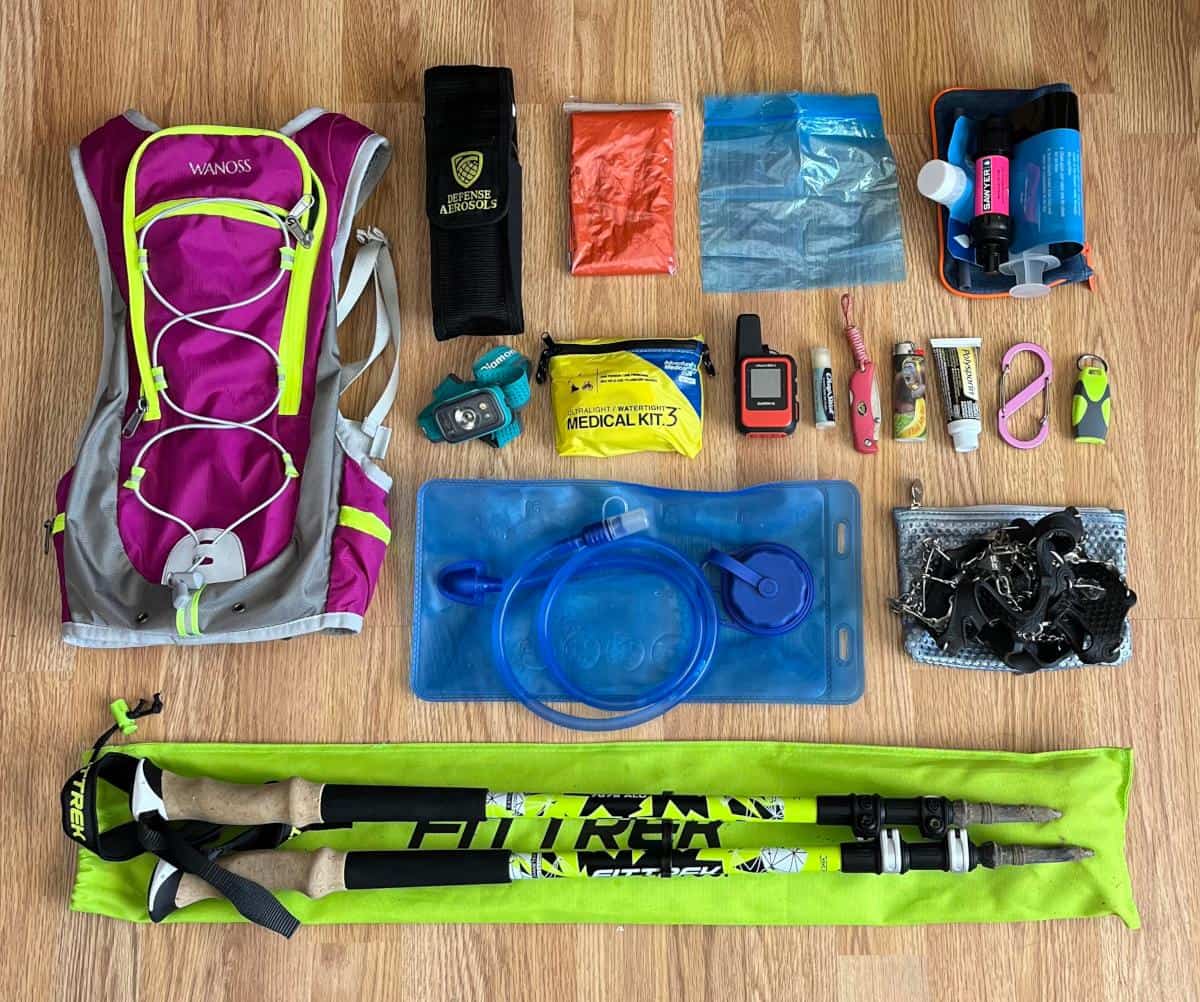
At the end of the day, your hiking backpack doesn’t have to look exactly like mine—or like anyone else’s. The goal is just to be prepared enough to handle the weird stuff that nature might throw at you. As long as you’ve got the basics covered and a little common sense, you’re doing great!


